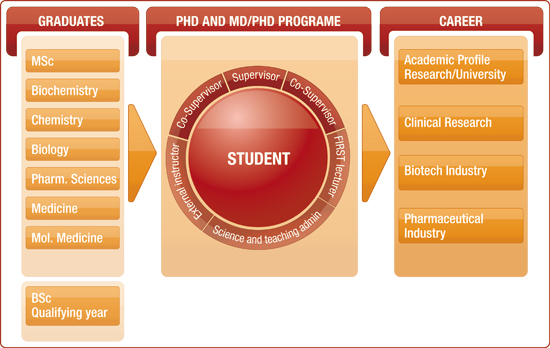
FIRST is open to students from pharmaceutical sciences, medicine, natural sciences, biotechnology and chemistry and aims to recruit excellent students. Prerequiste for admission will be a Master´s degree (MSc, MPhil), university diploma (Diplom) or state medical exam (Staatsexamen).
FIRST will award doctoral degrees in accordance with the regulations of the participating faculties.
In general, these regulations for awarding doctoral degrees require that the students have demonstrated the ability to understand, design, implement and critically evaluate a research process which has enabled them to make a contribution through original research. This must be done in a thesis and a successful presentation and defense of this thesis in public. FIRST does not have specific additional formal requirements for doctorates, but FIRST students are expected to have documented their research contribution by at least three national or international peer-reviewed publications, at least one as first author. FIRST PhD students are encouraged to write and defend their thesis in English.
The scientific progress of the PhD students during their studies is reviewed in the research meetings as well as during the FIRST Summer School by the supervisor and the 2 co-supervisors. Ideally, the 2 co-supervisors should have different backgrounds then the main supervisor, so that the PhD student has close personal contact with scientists having different expertises. The function of the supervisor team is to monitor the progress of each student and to encourage FIRST students in their endevours to develop and critically evaluate their research goals and strategies.
The 3-year curriculum
The transfer of key knowledge and skills specific to the field of drug research and development is a multi-stage, three-year process (plus an additional qualifying year for those graduates with a BSc/Fachhochschul-degree):
· Catch-up term & 1st year
Of primary concern in the first three months is to establish a common knowledge and methodical platform for all of the PhD students. Here, graduates from the natural sciences are introduced into medical terminology and pharmacology (Basics in Medicine & Pharmacology), while pharmacists and physicians aquire the basics in molecular and cellular biology (Molecular Medicine, Biological and Medicinal Chemistry). The first modules of the FIRST Core Curriculum on the basics in drug research, development, safety, as well as target identification and drug optimisation will be taught in the first year.
´
· 2nd & 3rd year
In the 2nd and 3rd years, the PhD students receive training in the fields of preclinical safety testing, animal models, drug formulation developement, clinical studies, German/European/international regulations (GMP, GLP, GCP, ICH), drug approval and basic marketing techniques (FIRST Core Curriculum). In the 2nd year, the PhD students take also courses such as Scientific Writing and Presentation, and one or two elective courses according to their interests and topic of their PhD research.
|